

-
Introduction to Biology7 Topics2 Quizzes
-
Recognizing Living Things3 Topics1 Quiz
-
Organisation of Life3 Topics2 Quizzes
-
Classification of Living Organisms6 Topics2 Quizzes
-
Kingdom Prokaryotae / Monera & Kingdom Protista4 Topics3 Quizzes
-
Kingdom Fungi & Kingdom Plantae10 Topics2 Quizzes
-
Kingdom Animalia I7 Topics1 Quiz
-
Kingdom Animalia II6 Topics2 Quizzes
-
The Cell4 Topics1 Quiz
-
The Cell Structure and Functions5 Topics1 Quiz
-
The Cell and its Environment5 Topics1 Quiz
-
Nutrition in Plants5 Topics1 Quiz
Quizzes

Topic Content:
- Structure of Bacteria
- Bacterial Shape
- Structure of Blue-green Algae
The simplest living organisms, the bacteria and the blue-green algae belong to Kingdom Monera . Bacteria are found inside living organisms, water, air and soil while blue-green algae are found on land, mainly in fresh water and damp areas.
Bacteria are of great importance to mankind. Some are harmful while others may be useful to us.
Structure of Bacteria:
The structure of bacteria is known for its simple body design. The diagram below portrays the structures and features of a typical bacterial cell.
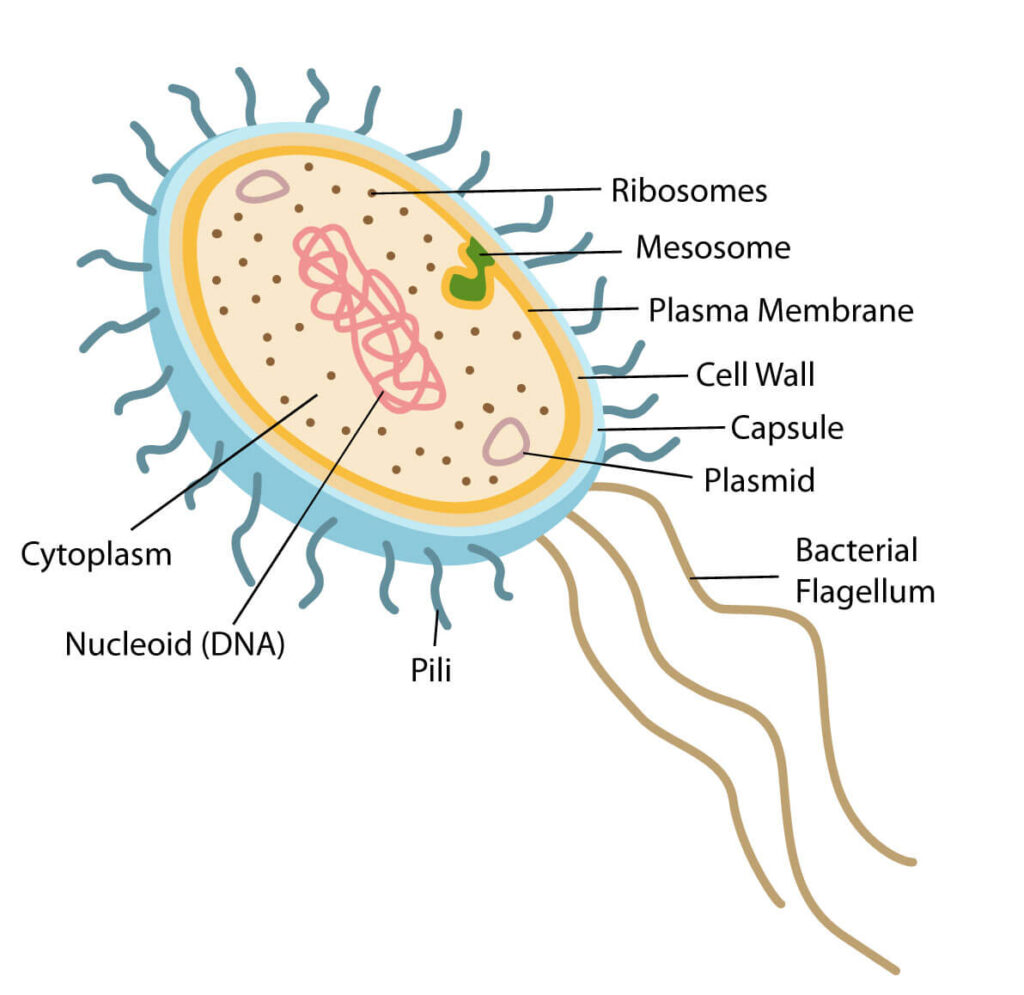
Capsule: Outside the cell wall is a thick slime layer, called a capsule. it is composed of polysaccharides and amino acids.
Cell Wall: All bacterial cells are protected by a strong, rigid cell wall which is inner to the capsule. They are therefore classified under plants. The cell wall consists mainly of peptidoglycan. Peptidoglycan is a polysaccharide consisting of sugars and amino acids
Plasma Membrane: The thin, elastic plasma membrane is situated just internal to the cell wall. The plasma membrane consists of both lipids and proteins and its function is to provide protection for the cell. It forms the boundary between the cell’s
Unlock This Topic
This topic is available to course subscribers.
Subscribe to continue this course.
- 📚 Continue this topic
- 📝 Attempt quizzes
- 📈 Track your learning progress
- 🪙 Earn KofaCoins
Like this content



 Liked by Zainab Raji and 4 others

Crystal clear