

Topic Content:
- To bisectBisect means dividing into two equal parts. It means to divide a geometric figure such as a line, an angle or any other shape into two congruent parts (or two parts... More a given line: To divide a line into two equal parts
- To bisect an angle: To divide an angle into two equal parts
- To copy an angle: To draw an angle similar to it
- Constructing Perpendiculars
- To construct an angle of 45°
- To construct an angle of 60°
- To construct an angle of 30°
- To construct an angle of 120°
- To construct an angle of 105o
- To construct an angle of 75°
- To construct angle 135°
- To construct angle 150°
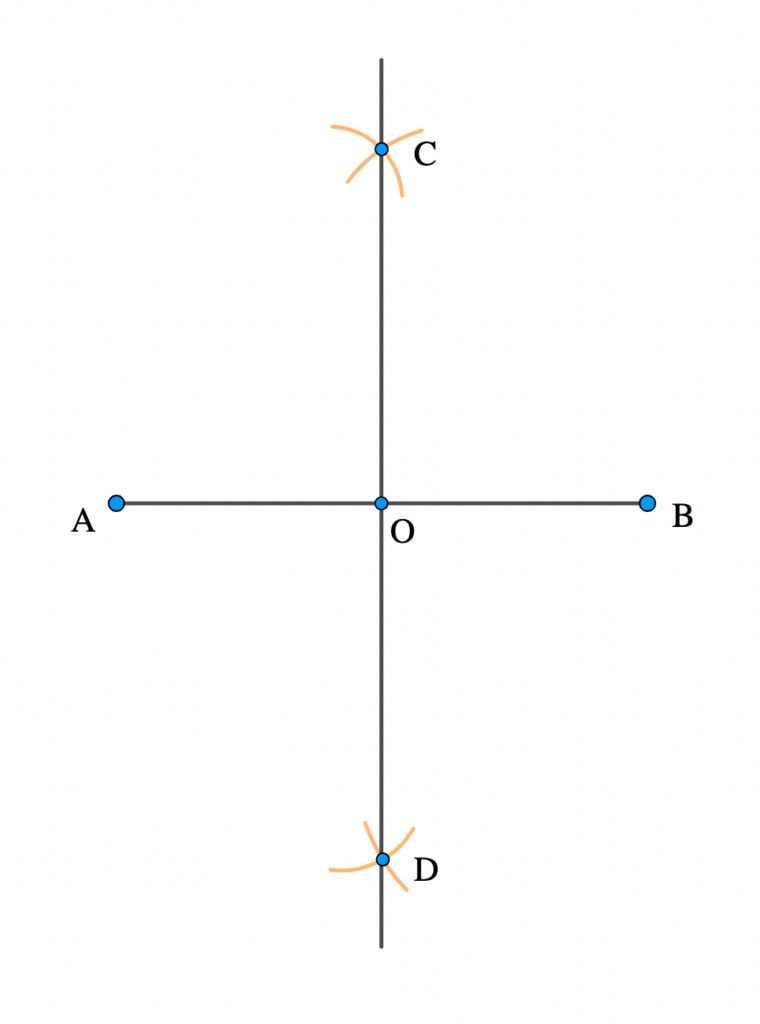
1. To bisect a given line: To divide a line into two equal parts
i. Draw a line AB (e.g. AB = 10 cm)
ii. Open your compass to a radius greater than half AB. Place the point of your compass on A and draw arcs above and below line AB.
iii. With centre B, using the same radius, draw arcs above and below line AB to cut the first two arcs at C and D.
iii. Draw a line to join C and D. Label the point where this line cuts AB as O. Since the line CD bisects AB at a right angle, CD is called the perpendicular bisector of AB, and point O is the mid-point of PQ.
2. To bisect an angle: To divide an angle into two equal parts e.g. ∠XYZ
i. Draw an angle, ∠XYZ

ii. With centre Y, at any convenient radius, use your compasses to draw an arc to cut YX and YZ at A and B respectively.

iii. With centre A using radius more than half AB, draw an arc, with centre B using the same radius, draw another arc to cut the first at C.

iv. Join YC. Thus YC bisects ∠XYZ.

3. To copy an angle: To draw an angle similar to it
To copy angle, ∠LMN

i. Draw the given angle with centre M and any convenient radius, draw an arc to cut ML at P and MN at Q.

ii. Draw the line YZ with centre Y and the same radius (i.e. MP) draw an arc to cut YZ at B.

iii. With centre B and radius equal to the distance of PQ, draw another arc to cut the previous one at A.

iv. Join YA and produce to a suitable point X. Thus ∠XYZ is similar to ∠LMN

4. Constructing Perpendiculars:
(a) To construct an angle of 90° at a point on a given line. Given a line PQ and a point R on the line, we can draw a perpendicular to PQ at R as follows:

i. With centre R and any convenient radius, draw two arcs to cut line PQ at L and M.

ii. With L and M as centres and a radius more than LR or RM, use your compasses to draw arcs above line PQ to intersect at D.

iii. Join RD to obtain the required perpendicular measure ∠DRQ to verify it is 90°.

(b) To draw a perpendicular to a line from a given point outside it.
- With centre R and at any convenient radius, draw arcs to cut line PQ at point L and M.
- With points L and M as centres and a radius more than half of LM, draw arcs to intersect each other at point D.
- Join RD to cut PQ at O. Thus RD is perpendicular to PQ.

5. To construct an angle of 45°
To construct angle 45°, first construct angle 90°. In this case, construct ∠DRQ. Then bisect it to obtain 45°.

6. To construct an angle of 60°
Steps:
i. Draw line DE
II. Indicate point F anywhere on DE
iii. Choose a convenient radius and draw an arc from centre F to cut DE at G
iv. With centre G and the same radius you chose in the previous step, draw an arc to cut the previous arc at H.
v. Draw a line from F through H, i.e line FI. Angle IFG is 60°

7. To construct an angle of 30°
i. Construct an angle of 60° like we did above.
ii. Bisect the 60° angle. Angle JFE is 30°

8. To construct an angle of 120°
i. Recall 120° = 2 x 60°, hence first construct angle 60° as described before. (This time let the arc cut at G and then D on the other side, forming a semi circle)
ii. With centre H, and the same radius used to construct the 60° angle, draw another arc to cut at J.
iii. Draw a line from F through J, i.e line JF. JFE is a 120° angle.

Alternate Method:
Recall sum of angles on a straight line is 180°.
As given above construction ∠HFG is 60° on the left hand side (LHS), thus the ∠IFD is 120°.

9. To construct an angle of 105o
i. With centre O and any convenient radius draw a semicircle to meet PQ at A and B
ii. Using A and B as centres and the same radius, draw two arcs to cut the semicircle at C and E.
iii. Using C and E as centres and the same radius, draw two arcs to cut each other at M.
iv. Join MO. Thus ∠QOL=90°
v. But ∠LOF = 30°. Bisect ∠LOF to obtain 15°. Hence ∠QOH = 15° + 90° = 105°

10. To construct an angle of 75°
Recall 75° + 105° = 180° (sum of angles on a straight line).
Therefore, construct angle 105° as above on the right hand side (RHS), i.e. ∠HOQ = 105°, hence the angle on the left hand side (LHS) is 75° i.e. ∠HOP = 75°

11. To construct angle 135°
Recall 45° + 135° = 180° (Sum of angles on a straight line).
Thus, by constructing angle 45° on the left hand side (LHS) i.e. ∠GOP=45°, therefore the angle on the right hand side (RHS) is 135° i.e. ∠GOQ= 135°

12. To construct angle 150°
Note that 150° + 30° = 180° (sum of angles on a straight line)
Hence, we can construct angle 30° on the LHS as given previously i.e. ∠GOP = 30°, thus the angle on the right hand side (RHS) is 150° i.e. ∠GOQ = 150°

Hint: It is important to know how to construct other angles by bisecting/combining/subtracting these angles depending on the side the angle is required.


