

-
Introduction to Physics6 Topics1 Quiz
-
Measurement I8 Topics1 Quiz
-
Measurement II8 Topics1 Quiz
-
Motion8 Topics1 Quiz
-
Rectilinear Acceleration and Motion Graphs8 Topics1 Quiz
-
Causes of Motion7 Topics1 Quiz
-
Work and Power5 Topics1 Quiz
-
Energy Transformation and Power5 Topics1 Quiz
-
Heat Energy8 Topics1 Quiz
-
Linear Expansion8 Topics1 Quiz

Topic Content:
- States of Matter
- Solids
- Liquids
- Gases
- Plasma
- Key Points
The kinetic molecular theory of matter explains the behaviour of matter in terms of the particles that make it up and their motion. Matter is made up of tiny particles such as atoms, molecules or ions. These particles are in constant motion, although the nature and extent of their motion differ in solids, liquids and gases.
An atom is the smallest particle of an element that retains the chemical properties of that element.
A molecule consists of two or more atoms chemically joined together and is the smallest particle of a molecular substance that can exist independently while retaining the chemical properties of that substance.
Solids:
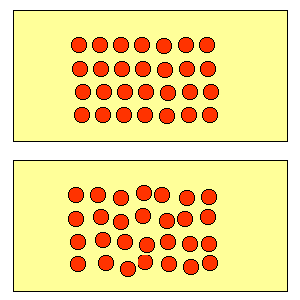
In a solid, the particles are closely packed and held in nearly fixed positions by strong forces of attraction. They cannot move freely from place to place, but they continually vibrate about their fixed positions. For this reason, solids have a definite shape and a definite volume.
Unlock This Topic
This topic is available to course subscribers.
Subscribe to continue this course.
- 📚 Continue this topic
- 📝 Attempt quizzes
- 📈 Track your learning progress
- 🪙 Earn KofaCoins
Like this content
 Liked by Akinyemi Victor and 2 others