

-
Linear Equations & Formulae5 Topics1 Quiz
-
Simultaneous Equations I2 Topics
-
Simultaneous Equations II2 Topics1 Quiz
-
Graphical Solution of Linear & Quadratic Equations2 Topics1 Quiz
-
Linear Inequalities3 Topics1 Quiz
-
Algebraic Fractions5 Topics1 Quiz
-
Circle Geometry I5 Topics
-
Circle Geometry II4 Topics1 Quiz

Topic Content:
- The Gradient of a Curve
Recall that the gradient of a straight line (a tangent) is constant at any point on the line. However, the gradient of a curve changes from point to point along the curve.
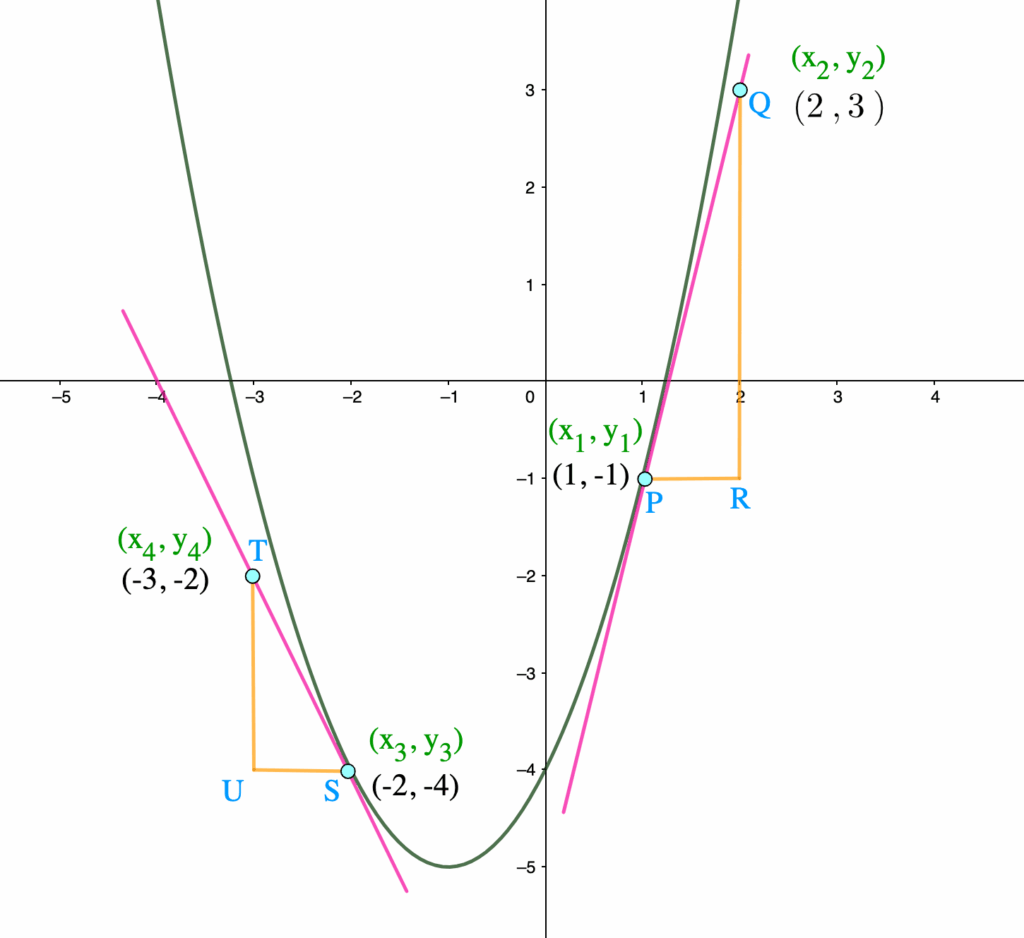
Consider the curve of y = x2 + 2x – 4 above:
Note that the gradient of the points P and S is the same as the gradient of PQ and ST gradient, respectively.
Gradient at P = \( \frac{y_2 \: – \: y_1}{x_2 \: – \: x_1} \\ = \frac{3\: – \: (-1)}{2\: – \: 1} \\ = \frac {4}{1} \\ = \scriptsize 4\)
Also Gradient at S = \( \frac{y_4 \: – \: y_3}{x_4 \: – \: x_3} \\ = \frac{-2\: – \: (-4)}{-3\: – \: (-2)} \\ = \frac {2}{-1} \\ = \scriptsize -1\)
It is important to note that the gradient at point P is positive because the tangent \(\scriptsize \overline {PQ}\)slopes upward from left to right. Also, the gradient at point S is negative because the tangent \( \scriptsize \overline {ST}\)slopes downwards from left to right.
Zero Gradient
Given y = ax2 + bx + c
The graphs below show that the gradient at the turning points is zero because the tangents at points P and Q (turning points) are parallel to the x-axis.


Point P and Q
Unlock This Topic
This topic is available to course subscribers.
Subscribe to continue this course.
- 📚 Continue this topic
- 📝 Attempt quizzes
- 📈 Track your learning progress
- 🪙 Earn KofaCoins
