

-
Scalars & Vectors5 Topics1 Quiz
-
Equations of Motion3 Topics1 Quiz
-
Projectile5 Topics1 Quiz
-
Equilibrium of Forces I4 Topics
-
Equilibrium of Forces II4 Topics1 Quiz
-
Stability of a Body4 Topics1 Quiz
-
Simple Harmonic Motion (SHM)4 Topics
-
Speed, Velocity & Acceleration & Energy of Simple Harmonic Motion5 Topics1 Quiz
-
Linear Momentum6 Topics1 Quiz

Relationship between Angular Acceleration & Linear Acceleration
Topic Content:
- Speed
- Acceleration
- Relationship between Angular Acceleration & Linear Acceleration
- Summary
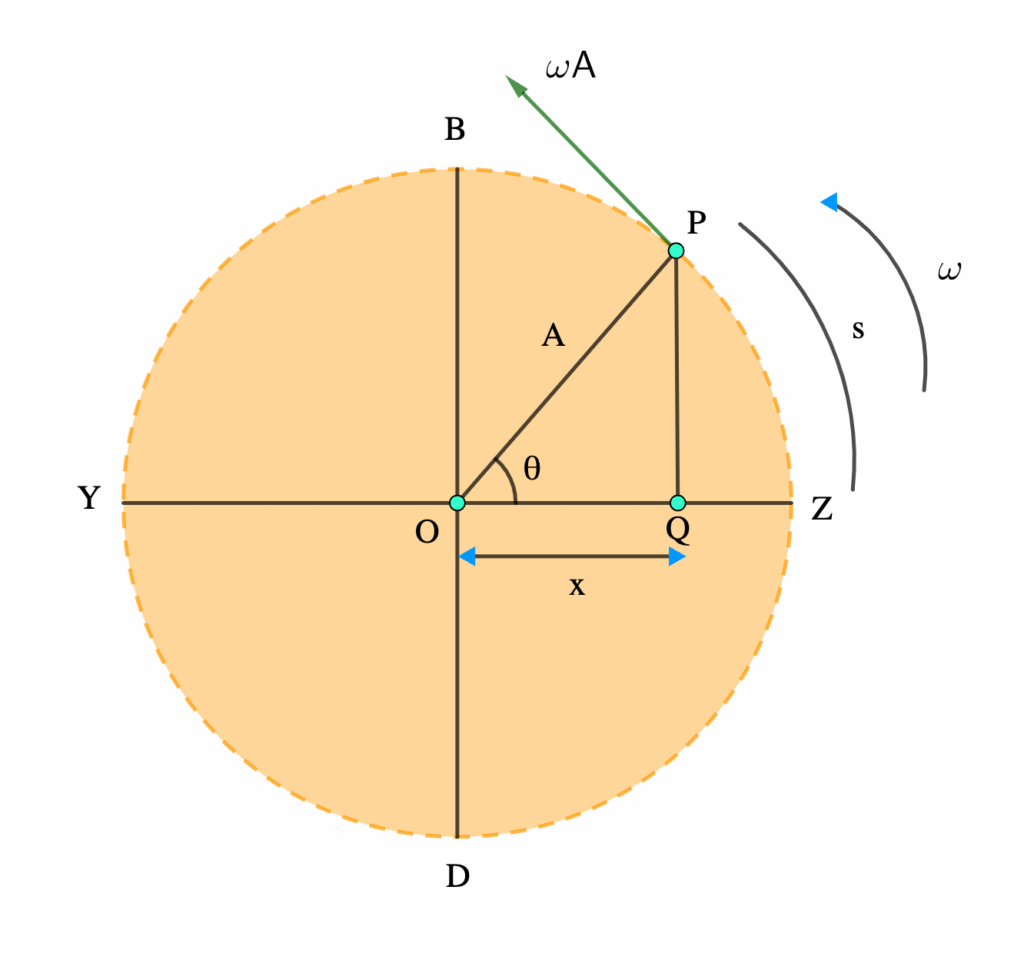
Speed:
From the diagram, as the particle P moves round the circle once it sweeps through an angle = 360º. Where 360º = 2π radians, in time T seconds.
The time rate of change of angle with time (t) is called the angular velocity (ω).
ω = \( \frac{angle \: turned \: through \: the \: body}{time \: taken} \)
ω = \( \frac{θ}{t}\)
∴ θ = ωt
This is similar to:
distance = velocity × time
s = v × t
∴ v = \( \frac{s}{t}\)for linear motion;
The angle θ is measured in radians
since, 2π rad = 360º
from, ω = \( \frac{θ}{t}\)
angular velocity is measured in radians per second (rad/s)
When θ changes with time, the length of the arc PZ = s, also changes with time.
By definition, θ in radians = \( \frac{s}{r}\)
s = r θ
Let r = A = radius of the circle.
The angular velocity (ω) is given by:
ω = \( \frac{θ}{t} = \frac{s}{r} \: \times \: \frac{1}{t} \)
= \( \frac{s}{t} \times \frac{1}{r} \)
\( \frac{s}{t} \)= v, the linear velocity of the particle.
Therefore;
ω = v. \( \frac{1}{r}\)
V = ωr = ωA.
Linear speed is the product of the angular speed and the radius or amplitude of motion.
Where,
v is
Unlock This Topic
This topic is available to course subscribers.
Subscribe to continue this course.
- 📚 Continue this topic
- 📝 Attempt quizzes
- 📈 Track your learning progress
- 🪙 Earn KofaCoins
Like this content
 Liked by Chike Amadi

Thank you 😊