

-
Waves I3 Topics1 Quiz
-
Light Waves3 Topics1 Quiz
-
Reflection of Light Waves at Plane Surfaces4 Topics1 Quiz
-
Curved Mirrors7 Topics1 Quiz
-
Refraction of Light7 Topics1 Quiz
-
Dispersion of White Light2 Topics1 Quiz
-
Refraction of Light through Lenses6 Topics1 Quiz
-
Application of Lenses in Optical Instruments10 Topics1 Quiz
-
Sound Waves7 Topics1 Quiz
-
Vibration in Springs & Pipes4 Topics1 Quiz

Topic Content:
- Simple Microscope (for Magnifying Glass)
- Compound Microscope
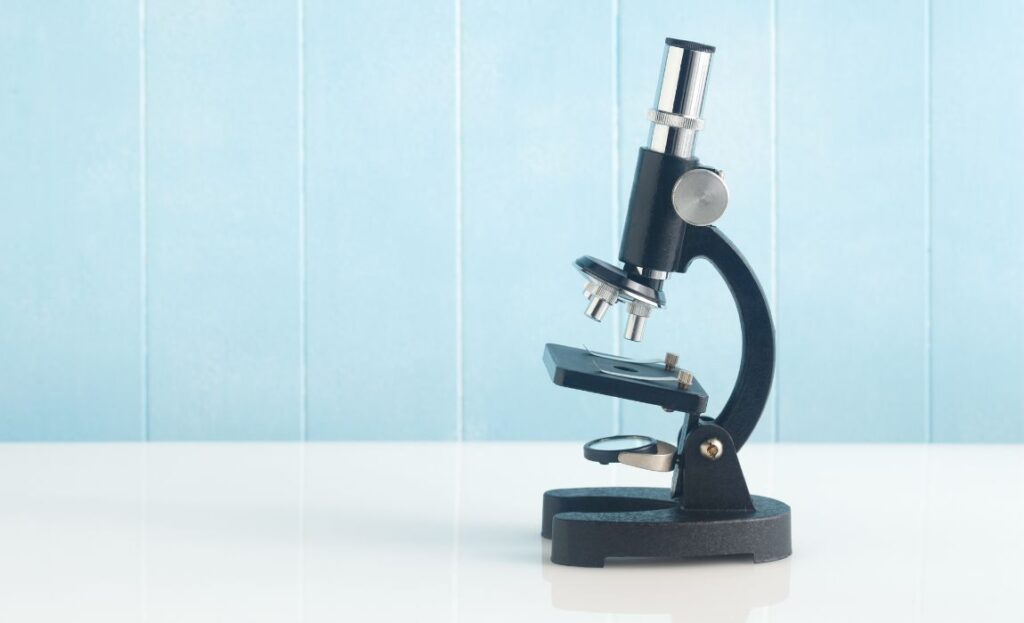
Simple Microscope (for Magnifying Glass):
This is a magnifying glass or convex lens used for producing erect, magnified images of a small object.
The image is virtual, erect, and magnified and is formed at the near point of the eye.

You are viewing an excerpt of this Topic. Subscribe Now to get Full Access to ALL this Subject’s Topics and Quizzes for this Term!
Click on the button “Subscribe Now” below for Full Access!
Subscribe Now
Note: If you have Already Subscribed and you are seeing this message, it means you are logged out. Please Log In using the Login Button Below to Carry on Studying!
The angle subtended by the eye is greater than the angle subtended by the object at the eye without a magnifying glass. The magnification of a simple microscope is:
M = \( \frac{v}{f} \scriptsize\; – \;1\)
M = \( \frac{D}{f} \scriptsize\; – \;1\)
- where D is the near point of the eye.
Compound Microscope:

The diagram shows a compound microscope in normal adjustment, that is, with the final image at the near point (25 cm from the eye) (distance D from the eye lens). This setting gives the maximum angular size of the image without eye strain.
It consists of two lenses of short focal lengths. The lens nearer the object is called the objective lens and the lens through which the final image is observed is called the eyepiece lens . The eyepiece has a larger focal point than the objective lens.
The objective
Unlock This Topic
This topic is available to course subscribers.
Subscribe to continue this course.
- 📚 Continue this topic
- 📝 Attempt quizzes
- 📈 Track your learning progress
- 🪙 Earn KofaCoins