
Back to Course

SS3: PHYSICS - 2ND TERM

0% Complete
0/0 Steps
  1. Magnetic Field
    10 Topics
    |
    1 Quiz
  2. Magnetic Field
    5 Topics
    |
    1 Quiz
  3. Electromagnetic Field
    4 Topics
    |
    1 Quiz
  4. Electromagnetic Induction
    7 Topics
    |
    1 Quiz
  5. The Transformer
    5 Topics
    |
    1 Quiz
  6. Simple A.C Circuit
    11 Topics
    |
    1 Quiz
  7. Models of the Atom
    2 Topics
    |
    1 Quiz
  8. Radioactivity
    3 Topics
    |
    1 Quiz
  9. Half Life
    8 Topics
    |
    1 Quiz
  10. Energy Quantization
    5 Topics
    |
    1 Quiz
  11. Photoelectric Effect
    6 Topics
    |
    1 Quiz
  12. Wave Particle Paradox
    6 Topics
    |
    1 Quiz
  • excellence
  • Follow

Lesson 3, Topic 4
In Progress

Moving Coil Galvanometer

Lesson Progress
0% Complete

Topic Content:

  • Moving Coil Galvanometer
  • Structure of a Moving Coil Galvanometer
  • Working Principle of Moving Coil Galvanometer
  • Advantages of Moving Coil Galvanometer
  • Disadvantages of Moving Coil Galvanometer
moving coil galvanometer

A galvanometer is one of the most sensitive and accurate devices for detecting and measuring extremely small currents or potential differences. It is calibrated for use as a milliammeter.

Moving Coil Galvanometer

Structure of a Moving Coil Galvanometer:

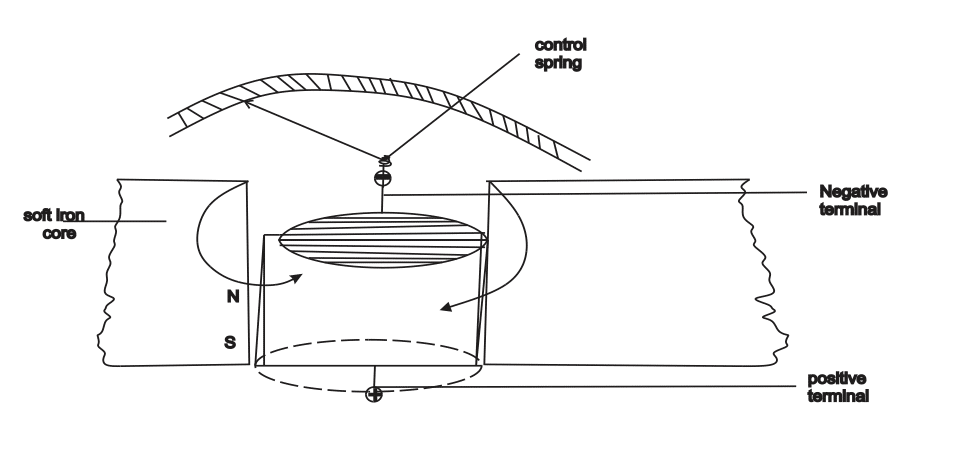
It consists of a rectangular coil of wire ABCD , wound around a soft iron cylinder or core (armature) placed between the two curved pole pieces of a horseshoe magnet. This arrangement produces a radial or uniform magnetic field in the air gap between the soft iron cylinder and the pole pieces.

The coil is pivoted on jewelled bearings or conducting rods so that it can rotate in the magnetic field when an electric current is passed through it.

The rectangular coil is connected to two phosphor-bronze control springs or hairsprings by two conducting rods.

These springs are made of a conducting material and also act as the “terminals” of the galvanometer, connecting it to an external electric circuit.

Current is led into and out of the coil by the two control springs wound in opposite 

🔒 Premium Content

Full lesson notes for the term are available to subscribers only.


891399

You are viewing an excerpt of this Topic. Subscribe Now to get Full Access to ALL this Subject’s Topics and Quizzes for this Term!

Click on the button “Subscribe Now” below for Full Access!

Subscribe Now

Note: If you have Already Subscribed and you are seeing this message, it means you are logged out. Please Log In using the Login Form Below to Carry on Studying!

  • ⚡ Instant grading & results
  • 📈 Student progress tracking
  • 📝 End-of-term examinations
  • 📄 Official student report cards
  • 🚫 Ad-free learning experience
  • 📱 Mobile & desktop friendly
🚀 Unlock everything with one subscription
Subscribe
Notify of
guest
0 Comments
Oldest
Newest
Inline Feedbacks
View all comments
0
Would love your thoughts, please comment.x
()
x
×
×