


Topic Content:
- Experiment 1 – To determine the Moisture
- Experiment 2 – To Determine the Presence of Living Organisms in the Soil
- Experiment 3 – Confirmation that Soil Sample Contains Air
- Experiment 4 – Determine the Porosity and the Water-Retaining Capacity of Different Soil Types
- Experiment 5 – Determine Percentage of Organic MatterOrganic matter is anything that contains carbon compounds that were formed by living organisms. It covers a wide range of things like lawn clippings, leaves, stems, branches, moss, algae, lichens any... More
Experiment 1 – To Determine the Moisture:
Title of Experiment: To determine the moisture content of a sample of soil that is moist.
Materials required: Soil sample, weighing balance, evaporating dish, stirring rod, wire gauze, bunsen burner, tripod stand.
Method:
- Weigh the mass of the empty evaporating dish.
- Place a sample of soil into the dish and re-weigh.
- Heat the dish with the soil with a Bunsen burner for two to three hours.
- Stir the soil constantly with the glass rod to aid evaporation.
- At the end of the period, the dish with the soil is cooled in a desiccator and reweighed.
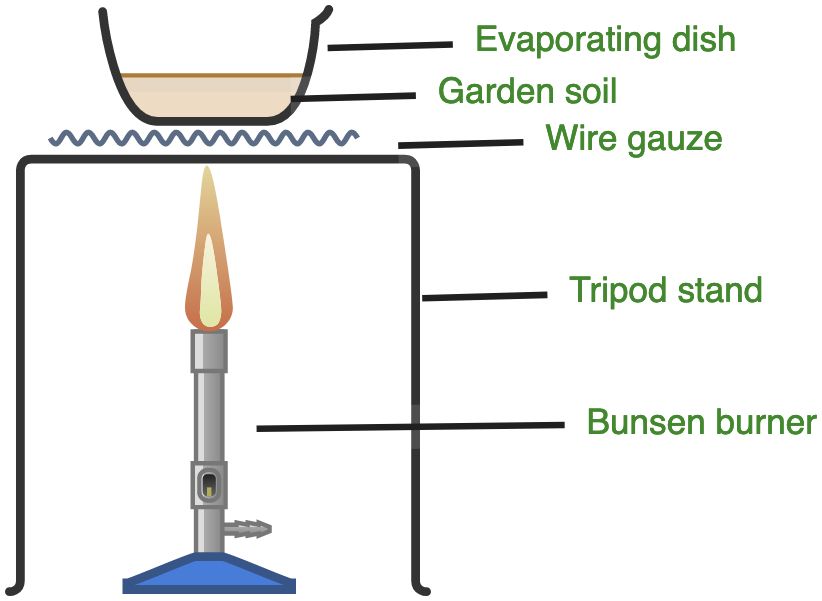
Results and Calculation:
Mass of empty evaporating dish = 30 g
Mass of dish + fresh soil = 45 g
Mass of fresh soil only [45 – 30] g = 15 g
Mass of dish + dried soil = 40 g
Mass of dried soil only = [40-30] g = 10 g
Mass of water driven off [15-10] g = 5 g
Percentage of water by mass
You are viewing an excerpt of this Topic. Subscribe Now to get Full Access to ALL this Subject's Topics and Quizzes for this Term!
Click on the button "Subscribe Now" below for Full Access!
Subscribe Now
Note: If you have Already Subscribed and you are seeing this message, it means you are logged out. Please Log In using the Login Button Below to Carry on Studying!
Responses