


This is a device used for comparing e.m.f of cells. It always gives accurate measurement of the e.m.f of a cell.
It consists of a length AB of wire of cross sectional area about 100cm long. A sensitive galvanometer is attached to a sliding jockey (J). The balance point is read from A on the meter rule when the galvanometer shows null deflection (read zero).
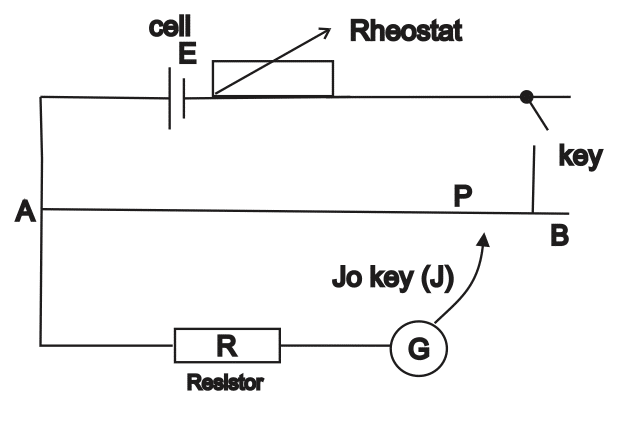
The potential difference across any length of the potentiometer wire is directly proportional to the length provided the wire is of uniform cross-sectional area. I.e. V ∝ L
Use of Potentiometer to Measure e.m.f
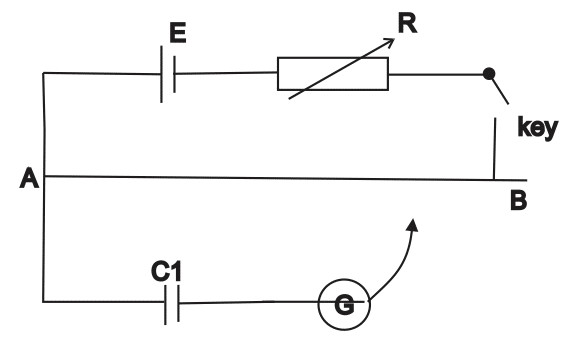
The circuit is connected as shown; the cell c1 whose e.m.f is required is introduced into the circuit, the positive c1 is joined to point A and negative terminal of c1 to the jockey through centre-zero galvanometer.
With the key closed, a balanced point is obtained at P, at this point; the P.d (V) across (AP) is equal to the e.m.f (E1) of C1, while the P.d between AP is directly proportional to length (C1) of AP.
ii E1 ∝ L1
If cell c1 is placed by another cell, c2 and the procedure repeated, a new balance point is obtained, such that E2 ∝ L2 then \( \frac{E_1}{E_2} =\frac{L_1}{L_2} \)
With this, the e.m.f of a cell can easily be obtained and it gives actual value since it is not driving any current through the circuit

Responses