


Topic Content:
- Temperature Scale Of Thermometer
- The Upper Fixed Point
- The Lower Fixed Point
- Fundamental Interval
- Conversion of Temperature From One Scale To Another
- Conversion of Celsius scale (°C) to Fahrenheit scale (°F)
- Conversion of Fahrenheit (°F) to Celsius Scale(°C)
- Conversion of Celsius (°C) to Kelvin Scale (K)
- Conversion of Fahrenheit (°F) to Kelvin Scale (K)
Temperature Scale Of Thermometer:
A thermometer has two reference temperatures or fixed points. These are the Upper Fixed Point and the Lower Fixed Temperature Point.
The Upper Fixed Point:
Upper fixed point (UFP) is the temperature of steam from pure water boiling at standard atmospheric pressure of 760 mm of mercury (760 mmHg).
The Lower Fixed Point:
The lower fixed point (LFP) is the temperature of pure melting ice at standard atmospheric pressure of 760mm of mercury (760 mmHg).
Fundamental Interval:
The difference between the upper fixed temperature point and the lower fixed temperature point of a thermometer is called the fundamental interval. The calibration of the fundamental interval of a thermometer depends on the temperature scale chosen.
Temperature Scales and Conversion refer to changing the value of temperature from one unit to another.
There are many temperature conversion methods. Among them, Kelvin, Celsius and Fahrenheit are the most commonly used methods.
The figure below shows the three different temperature scales, in °C, °F and K, that are used in measuring temperature.
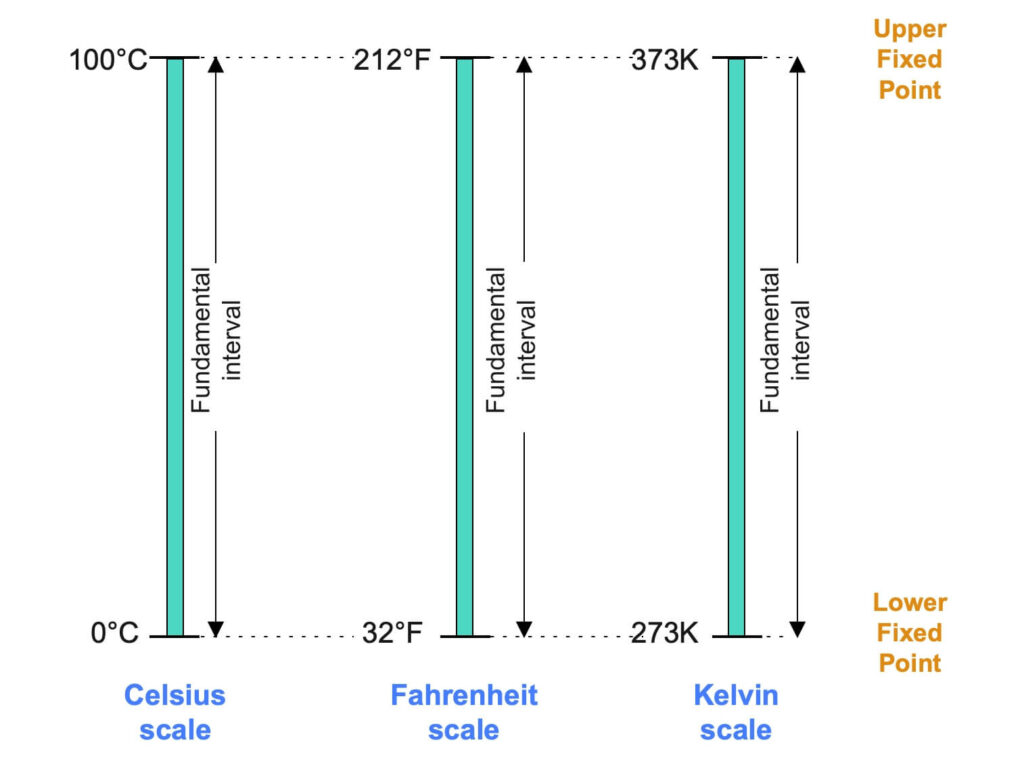
- Celsius scale: In this scale, LFP (ice point) is taken at 0°C and UFP (steam point) is taken at 100°C.
You are viewing an excerpt of this Topic. Subscribe Now to get Full Access to ALL this Subject's Topics and Quizzes for this Term!
Click on the button "Subscribe Now" below for Full Access!
Subscribe Now
Note: If you have Already Subscribed and you are seeing this message, it means you are logged out. Please Log In using the Login Button Below to Carry on Studying!
Responses