


Topic Content:
- Combining the Velocity-Time Graphs
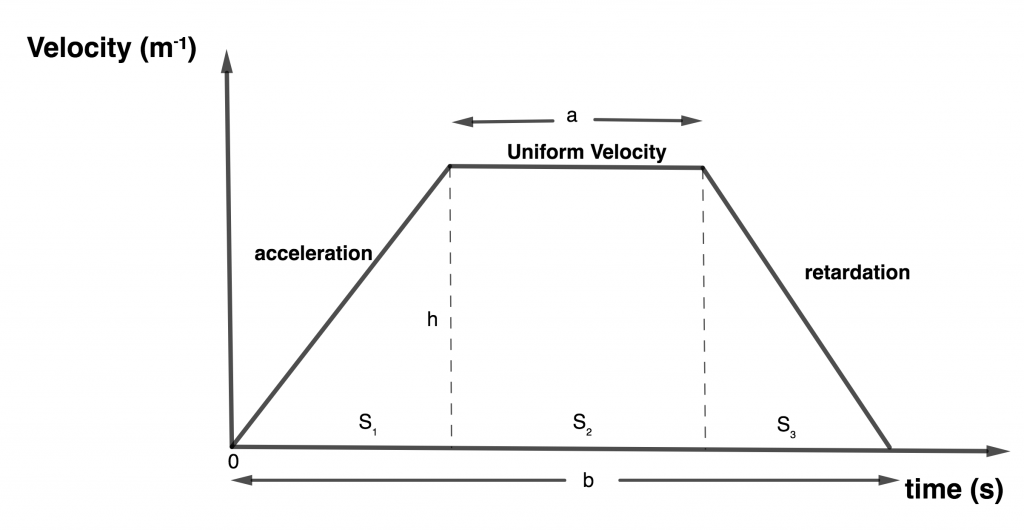
The total distance travelled is the total area under the graph from the graph, the shape is that of a trapezium.
∴ Total distance covered = Area of a trapezium
= \( \frac{1}{2}\)(Sum of parallel sides) x h
= \( \frac{1}{2} \scriptsize (a \: + \: b) \: \times \: h\)
Also, breaking the graph into components, S1, S2, S3
S1 is a right angle triangle = distance covered = Area of a right angle triangle
S1 = \( \frac{1}{2} \scriptsize \: \times \: base \: \times \: height \\ = \frac{1}{2} \scriptsize bh\)
S2 = Area of a rectangle = total distance covered = L x b
S3 = Area of a right angle triangle = \( \frac{1}{2} \scriptsize \: \times \: base \: \: \times \: height \\ =\frac{1}{2} \scriptsize bh \)
∴ the total distance covered = S1 + S2 + S3
You are viewing an excerpt of this Topic. Subscribe Now to get Full Access to ALL this Subject's Topics and Quizzes for this Term!
Click on the button "Subscribe Now" below for Full Access!
Subscribe Now
Note: If you have Already Subscribed and you are seeing this message, it means you are logged out. Please Log In using the Login Button Below to Carry on Studying!
Responses